This edition covers:
- What are peptides and why is everyone talking about them?
- What peptides are used for and whether or not they work
- The nuances of peptide regulation and safety, and the most recent panel recommendation to the FDA
As a licensed pharmacist, I’m always prepared to answer questions about medications (prescription or over-the-counter), and even herbal supplements to an extent. With new medications coming out every year and clinical guidelines constantly being updated, I know I signed up for a career that requires me to be a lifelong learner. However, I’m often surprised by the pharmacy-related topics that reach mainstream media. At the beginning of the GLP-1 explosion, I found myself brushing up on the laws surrounding compounding pharmacy and now I’m focusing on yet another “grey market” topic that everyone seems to be talking about: Peptides.
What are Peptides?
The peptide craze may seem like it came out of nowhere, but peptides aren’t exactly new. You likely heard the word "peptide" for the first time in a general science or biology class. Peptides are short chains of amino acids, the building blocks of protein. Our bodies produce thousands of peptides, which play important roles in our physiology. However, the peptides we’re talking about here can be introduced to the body through outside sources, often as supplements or wellness products. These peptide products are all over the news and social media, being sold anywhere from medspas and digital wellness platforms to Facebook Marketplace.
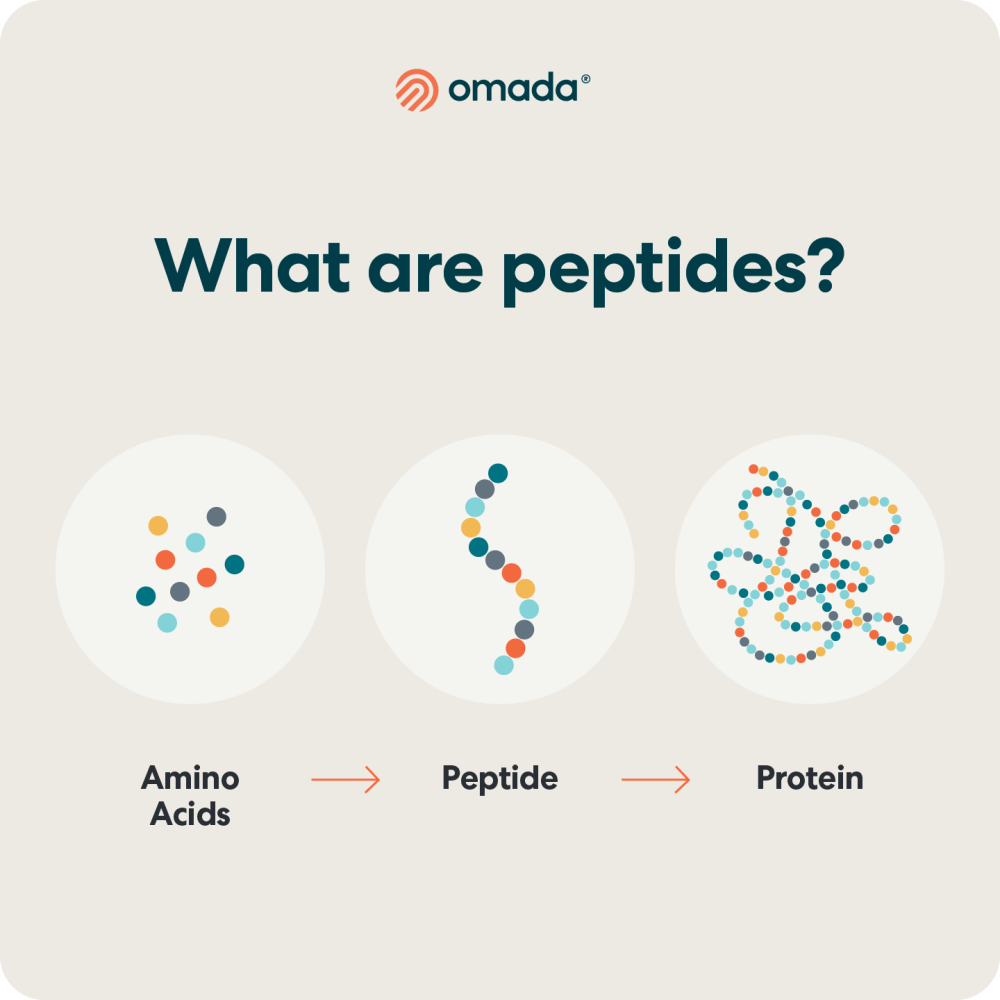
There are several FDA-approved peptides you’ve likely heard of, the first being glucagon-like peptide-1 (GLP-1) agonists. These weight loss medications are peptides that mimic naturally occurring peptides, such as GLP-1 (yes, our bodies make it naturally), glucose-dependent insulinotropic polypeptide (GIP), and glucagon. Other FDA approved peptide medications include:
- Insulin: For diabetes management
- Teriparatide (Forteo) & abaloparatide (Tymlos): For osteoporosis treatment
- Somatropin: Human growth hormone for short stature or clinical wasting
However, the peptides that are populating social media feeds are not FDA-approved treatments, so you may hear them referred to as “grey market peptides,” and they come in the form of injections, pills, or topical creams. According to the FDA these products fall under the category of “bulk drug substances” (since they’re not manufactured or listed as a finished product and need to be compounded by a pharmacist, see more below). They also appear to be named after secret agents:
- BPC-157 & Thymosin Beta-4 (TB-500): used to accelerate healing and for gut health
- CJC-1295: used for overall wellness, anti-aging, and faster recovery
- Semax and Selank: used for cognitive effects and neurological recovery
Sometimes these bulk substances are mixed with other molecules like NAD+ to theoretically make them work better. People tend to assume NAD+ is also a peptide, since it’s often marketed alongside GLP-1s or other peptides in a combination product as a longevity solution. However, it’s actually a naturally occurring coenzyme that decreases as we age. Its use in therapy is also not FDA-approved.
Are Peptides Legal if They’re not FDA Approved?
This is where things get interesting. There are nuances that dictate when and where peptides can be used legally, and the regulatory status is evolving quite a bit. Here’s a quick recap of recent history:
- 2023: The FDA reclassifies a list of peptide products as category 2 (restricted, see below), which resulted in many compounding pharmacies stopping product and providers halting prescribing.
- Early 2026: Health and Human Services (HHS) Secretary RFK Jr. publicly states that he’s a “big fan of peptides,” and wants to improve access to legitimate peptides.
- End of July 2026: The Pharmacy Compounding Advisory Committee (PCAC) met to review whether seven peptides should be reclassified to category 1, meaning they can be legally compounded. The panel recommended that the FDA reclassify six of the seven peptides.
What do the different categories mean? To give you an idea of how complicated this topic is, here’s a chart of how the FDA views different peptides. In red are some of the peptides that were just reviewed by the panel.
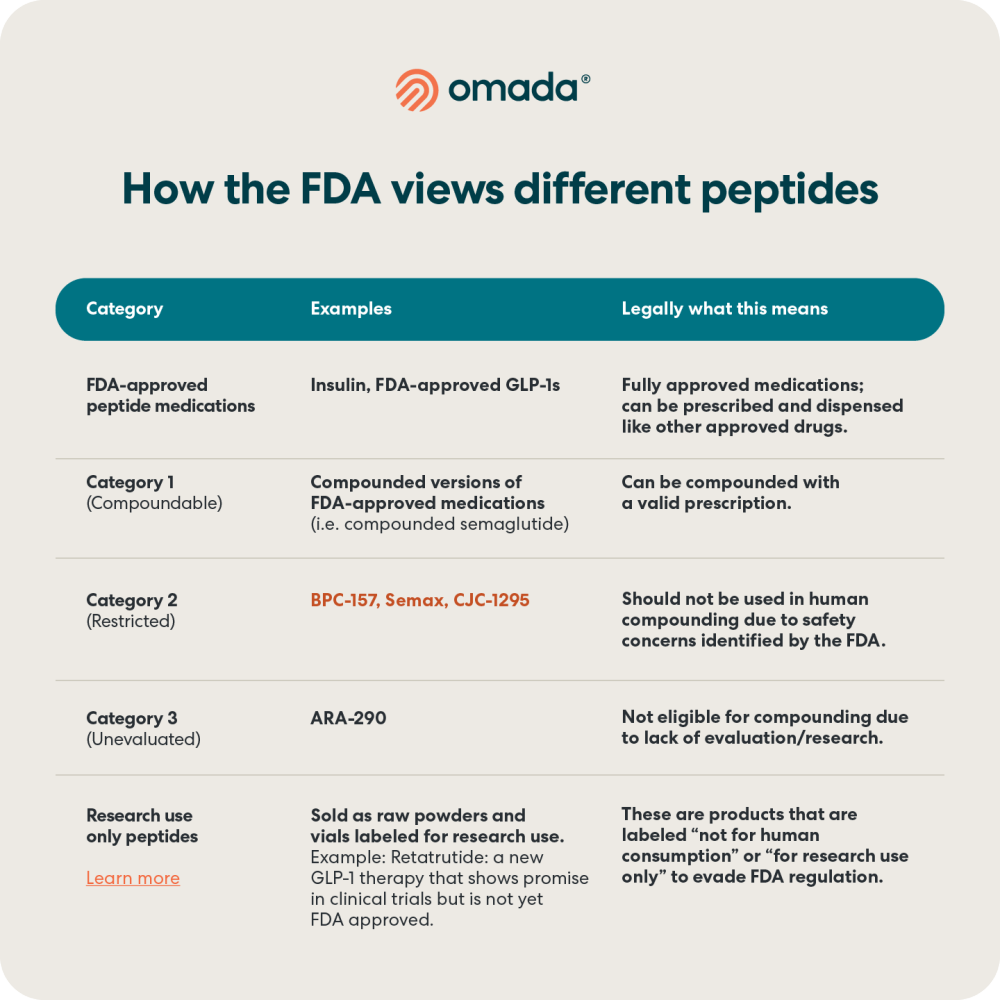
For the remainder of this piece we'll discuss category 2, category 3, and research use-only peptides.
Why are Peptides Getting so Much Attention?
It’s hard to pinpoint exactly why peptides are the talk of the town, but I suspect it’s a combination of a number of factors including:
- Growing interest in biohacking, longevity, and overall wellness
- The social media influencer and aesthetic medicine marketing
- Celebrity or influencer endorsements
- Word-of-mouth outcomes, e.g. “these peptides really work!”
- Growing distrust of traditional medicine
The final bullet hits home for me, as I’ve spent much of my career explaining how medications could benefit someone’s long-term health. Some of the hardest counseling sessions in my career were with patients who wanted to swap their prescribed medication with herbal supplements or natural remedies, saying that they preferred natural or alternative options over filling their bodies with chemicals, or because they didn’t want to continue to support big pharma. Wanting natural and alternative remedies is something I can relate to, however, we should always remember we don’t know for sure that these options are safe or effective.
The FDA approval process is a cross between a Tough Mudder and an ultramarathon. While it sometimes seems like a lot of red tape that leads to more expensive medications and a longer wait, keep in mind that these processes are set up to protect patients.
Before a medication gets submitted for FDA approval it has to go through a series of clinical trials to prove that it’s both safe and effective. The last step is a phase 3 clinical trial that’s usually a large randomized controlled trial (RCT), and is the only study type that can show causality, meaning RCTs can prove that a certain medication directly causes an outcome. This type of evidence is often missing in alternative treatment options such as non-approved peptides.
Do Peptides Actually Work?

Let’s look specifically at BPC-157, one of the more extensively researched peptides. Body Protection Compound (BPC) 157, has been studied for a number of uses including cancer and pain. It’s also received a lot of attention recently for its potential to aid in wound healing and regeneration. It’s important to note, that nearly all of the published literature for BPC-157 is in preclinical studies, meaning, non-human testing. Preclinical studies can be done in a lab or as animal studies and it’s important to note that successful preclinical results don’t always translate to success in humans. For context, of the thousands of compounds studied in preclinical trials, only a handful make it to human trials. Of the drugs that make it to clinical trials, about 14% eventually gain FDA approval.
Now, a very limited body of data studying BPC-157 in humans does exist. In 2021, a retrospective study found that 14 out 16 patients injected with BPC-157 reported significant improvement in knee pain. I know what you’re thinking. An 88% success rate sounds great! And it does! However, we can’t ignore the limitations of this study. It’s a very small study, looking at BPC-157 in a very specific population, and it lacks a control group.
To put this in perspective, let’s look at a compound that’s currently going through the clinical trial process for the same use. PTP-01 (Motys) is an injection currently being studied for the treatment of knee osteoarthritis. Its current phase 3 clinical trial is prospective (generally more powerful than retrospective), and is enrolling 260 people, with half of those individuals being randomized to a control group. These are the types of studies that clinicians are looking for when it comes to recommending or prescribing treatments, which is lacking for non-FDA approved peptides.
Are Peptides Safe?
During clinical trials, researchers don’t just look at the effectiveness of a potential medication, but also safety concerns. That means they’re looking at side effects, adverse reactions, and determining if medications aren’t safe for certain individuals. Safety monitoring doesn’t stop at FDA approval. Once a medication is on the market, the FDA oversees post-marketing surveillance that can reveal more rare or long-term adverse effects or concerns that didn’t happen during clinical trials. Since we’re talking about unregulated peptides, there is no governing body that’s collecting and analyzing safety data, though we’ve seen reports in the media.
Other factors that may impact the safety of peptides is how you’re using them and where you’re getting them from. If you’re using a peptide product that’s applied to the skin or taken orally it’s less risky than a peptide product that’s injected. That’s because injected products bypass your body’s natural defense systems, such as your skin barrier or digestive tract. So if an injected product is contaminated with bacteria, you are injecting bacteria directly into the bloodstream putting you at risk for a serious blood infection. This brings up the importance of getting peptides from a reputable source, which can be challenging given the lack of regulation. This is one of the reasons proponents of peptides want the FDA to reclassify these treatments, stating that the current policies don’t actually reduce demand for them, but push consumers to less regulated and potentially dangerous sources.
Are Peptides Right for Me?
There’s a chance you have found your way to this article because you’re wondering if peptides are right for you. Unfortunately, I will not be able to answer that question, especially without knowing more about you and your situation. In fact, I don’t recommend taking medical advice from what you read on the internet, although it is a great place to start to get educated on topics to discuss further with a trusted healthcare professional.
All medications come with side effects and risks, so if a healthcare professional recommends a medication for an individual, it means they believe the benefits of the medication outweigh its risks.
With unregulated peptides, especially injected products, I currently see a lot of risks, but also potential benefits. As a general rule of thumb, I would recommend that the majority of people first try the FDA-approved treatment options before exploring novel unapproved treatments, especially if we’re talking about injected products.
I understand that sometimes it feels like healthcare moves at a snail's pace, and I promise that clinicians feel the same way. Still, we respect the process of gathering enough information and data to guide proper decision-making. With that being said, if there aren’t any FDA approved treatment options for your concern, or you’ve exhausted them all, then perhaps widen your search and consult a trusted healthcare professional (not just your favorite AI agent), who can review your personal situation to determine if a non-approved peptide treatment is right for you.



